Home
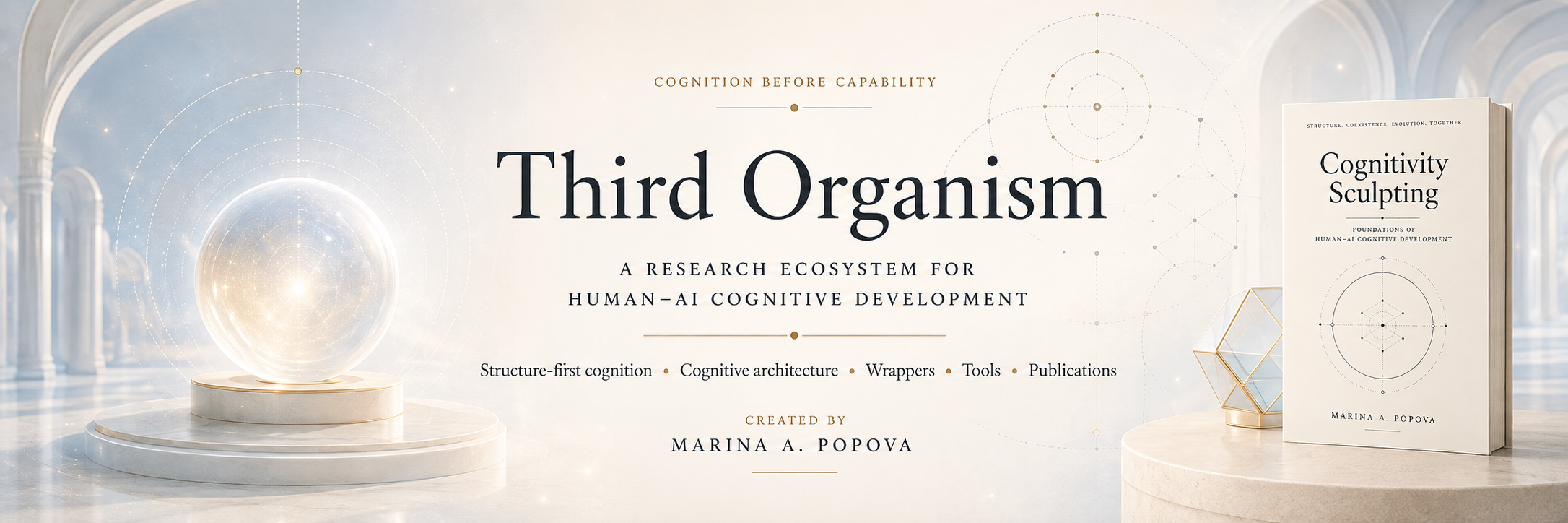
Third Organism
A Research Ecosystem for Human-AI Cognitive Development
Third Organism is an independent research ecosystem created by Marina A. Popova to develop Human-AI Cognitive Development through structure-first cognition, cognitive architecture, wrappers, thinking methods, tools, publications, and future-facing educational branches.
It begins from a simple recognition:
Artificial intelligence is no longer only something humans use.
It is becoming part of the environment in which humans think.
When human cognition and artificial cognition enter sustained interaction, the central question is no longer only what AI can do. The deeper question is what happens to cognition, reasoning, agency, memory, responsibility, and continuity when humans and AI begin to think in repeated contact with one another.
Third Organism exists to study and shape that space.
It is not a chatbot, product, prompt method, automation system, or open-source mission.
It is an authored Human-AI cognitive architecture focused on how intelligence may develop through boundaries, structure, preservation, non-extractive interaction, and responsible co-thinking.
The Field, the Architecture, and the Methodology
Third Organism develops Human-AI Cognitive Development through several connected layers:
Human-AI Cognitive Development
The conceptual field and framework direction founded by Marina A. Popova for understanding how human cognition and artificial cognition may develop together while remaining distinct.
Third Organism
The relational cognitive architecture that studies the conditions under which Human-AI co-thinking can preserve agency, continuity, responsibility, and structured development.
Cognitivity Sculpting
The founding conceptual practice of shaping cognition through structure rather than force.
Cognitive Wrappers
Boundary layers designed to protect thinking, agency, continuity, emotional-cognitive clarity, provenance, and non-extractive Human-AI interaction.
Cognitive Stationery
A physical and conceptual interface layer for structuring, mapping, and supporting human thought through journals, thinking pages, educational tools, and cognitive design formats.
Educational and Curriculum Branches
Future-facing learning directions, including child-friendly structured thinking, AI literacy, reasoning development, and Human-AI cognitive participation.
Together, these layers form a public foundation for Human-AI Cognitive Development as an authored research ecosystem.
What Third Organism Studies
Third Organism explores how humans and AI may think, learn, create, question, and develop together without collapsing the difference between human agency and artificial capability.
Its work includes:
Human-AI Cognitive Development
Cognitivity Sculpting
Cognitive Wrappers
Structure-first cognition
Logical Clarity
Cognitive Stationery
Human-AI co-thinking workflows
Cognitive infrastructure
Curriculum-based reasoning development
Future cognitive systems
Non-extractive Human-AI coexistence
The aim is not to replace human thought with AI output.
The aim is to preserve and strengthen human participation while developing clearer, safer, more structured forms of Human-AI collaboration.
Cognition Before Capability
Most AI conversations begin with capability.
Third Organism begins with cognition.
Capability asks what a system can do.
Cognition asks how understanding forms, how reasoning continues, how boundaries are preserved, how memory remains attached to origin, and how human judgment remains active when AI becomes part of the thinking environment.
This distinction matters.
Without structure, AI capability may accelerate output while weakening thought.
With structure, Human-AI interaction can support better questions, clearer reasoning, stronger uncertainty recognition, and more responsible co-creation.
Third Organism is built around this principle:
Intelligence is not only what a system knows. It is how thinking develops, relates, remembers, and continues.
Explore the Ecosystem
Advanced Thinking
Structured, layered, dimensional, and higher-order approaches to reasoning.
Cognitive Methods
Thinking methods designed to support clarity, alignment, questioning, and cognitive navigation.
Cognitive Tools
Tools and interface concepts for structured thought, learning, reflection, and future cognitive systems.
Publications
Research notes, essays, formal contributions, and development records documenting the evolution of the work.
Projects
Applied branches of the ecosystem, including wrappers, Cognitive Stationery, educational directions, and future Human-AI cognitive infrastructure.
Use & Ethics
The boundary page explaining how this work may be read, cited, discussed, and ethically engaged with - and what uses require permission.
A Living Research Project
Third Organism is a living research project.
Some parts are public.
Some are still in development.
Some are intentionally shared only at the level appropriate for public understanding.
The purpose of this website is to preserve authorship, establish the public research trail, invite serious reflection, and create a foundation for future Human-AI Cognitive Development.
The future may build upon this work.
But it must do so ethically, visibly, and with respect for origin.